

You are typing an email, a school essay, or a text message. You reach the part where you want to say “wait up to this moment,” and your fingers pause. Is it one L or two? The until vs. untill question trips up a surprising number of writers, even careful ones, and it can make a strong sentence look sloppy.
Here is the short version. Until is the correct spelling. Untill is a misspelling in modern English. This guide explains the until vs. untill debate in plain language, with examples, tables, memory tricks, and grammar rules, so you can settle the question once and move on with confidence.
By the end, you will know why the extra L sneaks in, how to fix it, and how to use until in every kind of writing. Whether you are a student, a professional, or an English learner, the answer to until vs. untill will be simple to remember.
Quick Definition
Until is a word that marks the point in time when something stops or changes. It works as a preposition and as a conjunction. It answers the question “up to when?”
Untill has no standard definition. It is a common typing and spelling error for until. When people search for until vs. untill, they usually want to confirm that the single-L version is the right one.
Tip: If you ever doubt a spelling, remember that the correct word has exactly two syllables and exactly one L at the end: un-til.
Quick Answer
In the until vs. untill debate, the winner is clear. Write until with one L. Every major dictionary lists it that way, including Merriam-Webster, Oxford, Cambridge, and Collins.
The form “untill” will be flagged by spell checkers, editors, teachers, and professional style guides. Using it can make your writing look careless, even when your ideas are strong.
- Correct: I will wait here until you arrive.
- Incorrect: I will wait here untill you arrive.
That is the whole rule. The rest of this article helps you understand it deeply so you never second-guess it again.
Read More: Until Or Untill Key Differences
Until Or Untill Comparison Table
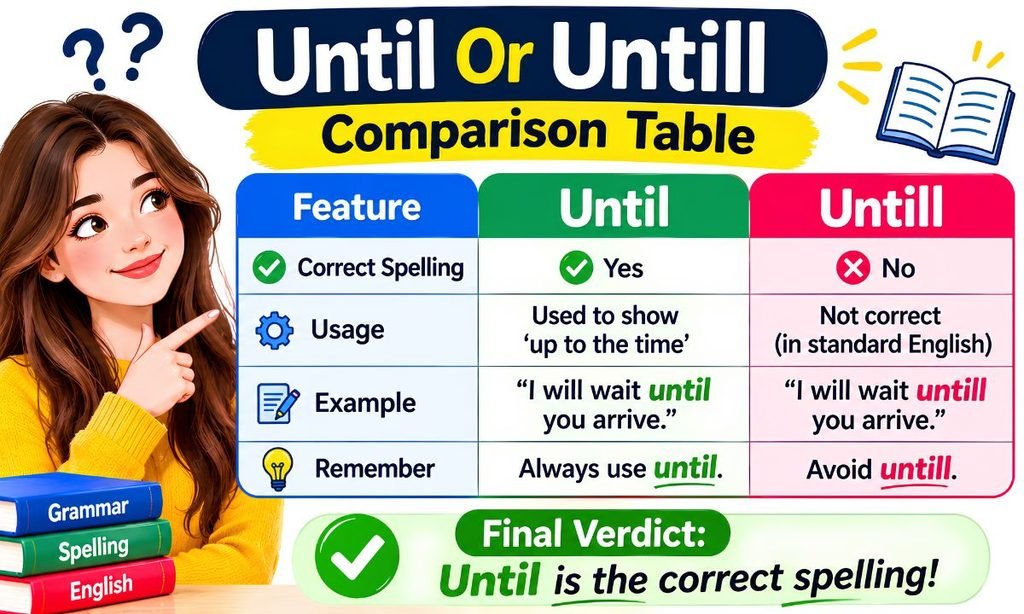
This table sums up the until or untill choice at a glance. You can scan it in ten seconds and walk away with the answer.
| Feature | Until | Untill |
|---|---|---|
| Correct spelling | Yes | No |
| Number of L letters | One | Two |
| Found in dictionaries | Yes | No (not as a standard word) |
| Syllables | Two (un-til) | Written as two, but wrong |
| Part of speech | Preposition and conjunction | None |
| Accepted in formal writing | Yes | No |
| Spell checker reaction | Passes | Flagged as an error |
| Example | Wait until noon. | Wait untill noon. |
When you compare until vs. untill side by side like this, the pattern is easy to see. One is a real word. The other is a slip.
Meaning Of Until
Until means “up to the time that” or “as late as.” It marks the moment an action, state, or condition ends or changes.
Think of it like a finish line. Everything before the line is covered by the sentence. Once you cross the line, something new begins.
- The store stays open until 9 p.m. (The line is 9 p.m.)
- She studied until she understood the lesson. (The line is understanding.)
- Do not open the oven until the timer rings. (The line is the timer.)
Until can point to a clock time, a date, an event, or even a condition. That flexibility is why it shows up in so many sentences each day.
Etymology
The history of until helps explain the until or untill confusion. The word grew out of Old Norse roots. The prefix und meant “up to,” and it joined with till, which meant “to” or “up to a time.”
In Middle English, spelling was not fixed. Writers often spelled words in several ways, and older texts sometimes show forms with a doubled L. Over time, printing and dictionaries settled the spelling as until.
So the single L is not random. It is the result of centuries of standardizing English spelling.
Until vs untill grammar
From a grammar view, the until vs untill question is simple. Until is a real word with a clear job. Untill has no grammatical role at all.
Until can do two jobs:
- Preposition: It comes before a noun or time phrase. (We waited until Friday.)
- Conjunction: It joins two clauses. (We waited until the rain stopped.)
Untill cannot be classified as either one, because it is not a recognized word. A grammar checker will not assign it a part of speech. It will only mark it as misspelled.
Tip: When you test your grammar knowledge, ask yourself, “Can I replace the word with ‘up to the time that’?” If yes, you need until, spelled with one L.
Until Or Untill Key Differences
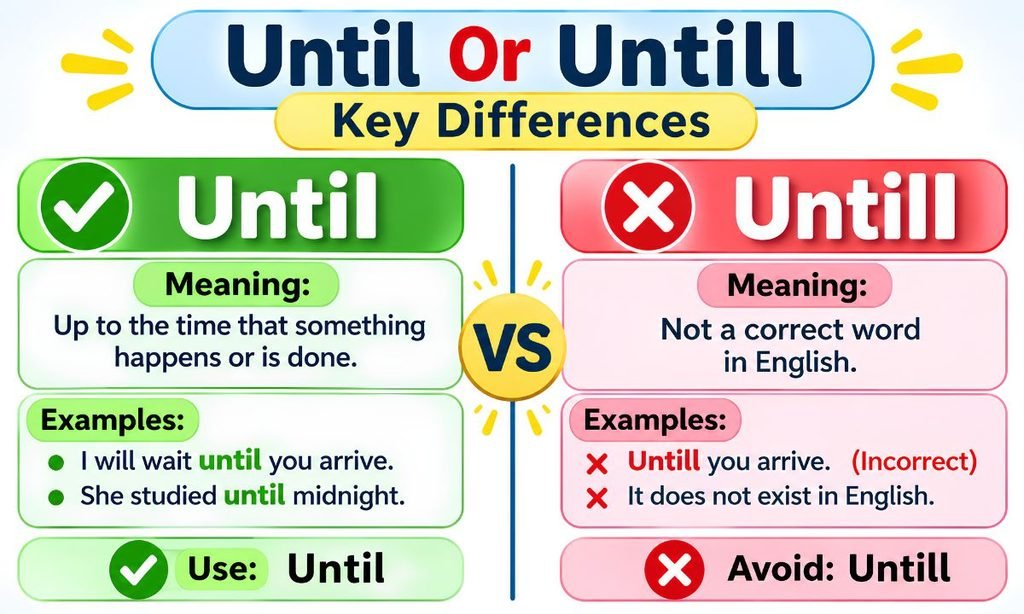
The differences in the until or untill pair come down to spelling, status, and trust. Here are the main points in short form.
- Spelling: Until has one L. Untill has two.
- Status: Until is standard English. Untill is an error.
- Dictionary support: Until appears in all major dictionaries. Untill does not appear as a standard entry.
- Reader perception: Until looks professional. Untill looks like a typo.
- Software support: Until passes spell check. Untill gets a red underline.
There is no difference in meaning, because untill has no meaning of its own. People who write it are almost always trying to write until.
Until Or Untill Which One Is Correct
When you ask which one is correct in the until or untill choice, the answer is until. There is no region, style guide, or exam board that accepts untill as correct.
Some writers wonder if untill might be an older or British form. It is not. American, British, Australian, and Canadian English all use the single-L spelling.
If you see untill in a published book, news article, or website, treat it as a mistake. Even good publications make typos sometimes, but that does not make the error right.
Until vs untill reddit
Online forums, including Reddit, are full of questions like “Is it until or untill?” People ask them in language communities, writing groups, and study threads. The until vs untill reddit conversation usually follows the same pattern.
Someone shares that they saw untill in a post or a caption. Others reply with the same answer: one L, always. Many commenters point out that spell check would catch it, and some share memory tricks.
The lesson from these discussions is useful. Forums are great for quick help, but they are not authority sources. Always confirm with a dictionary. When you check, the dictionary agrees with the crowd: until is correct.
Examples Using Untill
These examples show how untill appears in the wild. Each one is wrong, and each one comes with the fix. Studying mistakes can make the right form stick.
| Incorrect (with untill) | Correct (with until) |
|---|---|
| Please wait untill I call you. | Please wait until I call you. |
| The meeting runs untill 4 p.m. | The meeting runs until 4 p.m. |
| He did not leave untill midnight. | He did not leave until midnight. |
| Stay calm untill help arrives. | Stay calm until help arrives. |
| I will work untill the job is done. | I will work until the job is done. |
Notice that nothing else in the sentence changes. You only remove one L. That small fix makes the sentence correct and clean.
Common Mistakes
Most until vs. untill errors come from habit, speed, or imitation. Knowing the cause makes it easier to prevent the mistake.
1. Adding An Extra L
The most common error is simply adding a second L at the end. The word looks like it should have a double letter, so the hand adds one.
The fix is easy. Say the word slowly: un-TIL. You hear one L sound, so you write one L.
2. Assuming Both Spellings Are Acceptable
Some writers believe English allows many spellings for the same word. In some cases that is true, such as “grey” and “gray.” But the until or untill choice is not one of those cases.
Only one version is accepted. Do not assume that a spelling is fine just because you have seen it before.
3. Copying Online Errors
Social media, comments, and quick messages spread errors fast. If you read untill many times, your brain may start to treat it as normal.
This is why reading edited writing matters. Books, news sites, and academic papers are proofread, so they protect your spelling instincts.
4. Confusing Familiar Patterns
English has many words with double L at the end, such as “still,” “skill,” “will,” and “chill.” Your brain sees the “-ill” pattern and applies it to until.
But until follows a different path. Its ending, -til, comes from “till,” and it lost one L when the words joined together. Pattern matching can fool you, so trust the dictionary.
Until Or Untill Pronunciation Guide
Pronunciation does not help you spot the until or untill difference, because both forms would sound the same if spoken. That is exactly why the error spreads. The sound gives no clue about the spelling.
Still, knowing how to say the word correctly is useful. It helps in speaking, in teaching, and in remembering the shape of the word.
IPA
The International Phonetic Alphabet shows the sound of until in American English as /ʌnˈtɪl/ or /ənˈtɪl/. Both are common. The first vowel can be a full “uh” sound or a softer, relaxed one.
The second vowel is the short “i” sound, like in “sit.” The word ends in a clear L.
Syllables
Until has two syllables: un-til. Many people add a third beat by accident when they spell untill, but the word is still said in two beats.
Tapping your finger twice while saying it can help you count the beats.
Stress
The stress falls on the second syllable: un-TIL. The first syllable is quick and light. The second one is stronger and longer.
This stress pattern is the same in American, British, Australian, and Canadian English.
Common Pronunciation Mistakes
Learners and fast speakers sometimes make these slips:
- Stressing the first syllable (UN-til instead of un-TIL).
- Dropping the final L so it sounds like “unti.”
- Using a long “i” sound, which would make it sound like “un-tile.”
- Mixing it up with “intil,” a rare form that is not used in standard English.
Practice by saying full sentences out loud. “Wait until Monday” is a good one.
Etymology And Word Origin
The story of until vs. untill goes back to the early history of English. Understanding the origin shows why the single L is correct.
The word till came into English from Old Norse and Old English roots, where it meant “to” or “up to.” It is actually older than until. Many people believe till is a shortened form of until, but history says the opposite.
The word until formed when the old prefix und, meaning “up to,” was attached to till. During the Middle English period, writers spelled it in different ways, and a form with double L could appear in manuscripts.
As printing spread and dictionaries became common, one standard spelling won out. By the time modern dictionaries arrived, until, with a single L, was the accepted form.
Tip: Remember that “till” is the older word and “until” is built from it. Both are correct today, but untill is not.
Until Or Untill In Different Types Of English
The until or untill question gets the same answer in every major English-speaking region. No national variety has adopted untill as standard.
There are small differences in how people use until and till, and these differences are about style, not spelling. Here is how each major variety treats the word.
American English
In American English, until is the standard form in both formal and everyday writing. Till is common in speech and casual writing, and ’til appears in informal notes and song lyrics.
American style guides recommend until for business, academic, and professional work.
British English
British English also uses until as the standard spelling. Till is widely used in speech and is considered perfectly normal in everyday writing.
British writers sometimes lean on till more often in casual text than Americans do, but untill is still wrong.
Australian English
Australian English follows the same rule. Until is standard, and till is common in conversation. For example, “I’ll wait till Friday” is a very natural Australian sentence.
The spelling untill is not recognized in Australian dictionaries or style guides.
Canadian English
Canadian English blends American and British habits in many areas, but not here. Until is the correct form, and till is an accepted casual alternative.
Canadian schools and publishers mark untill as an error.
Regional Usage Comparison
This table summarizes how the until vs. untill issue plays out across regions. It is easy to use as a quick reference.
| Region | Until | Till | ‘Til | Untill |
|---|---|---|---|---|
| United States | Standard | Common in speech | Informal only | Incorrect |
| United Kingdom | Standard | Common | Rare | Incorrect |
| Australia | Standard | Common | Rare | Incorrect |
| Canada | Standard | Common | Informal only | Incorrect |
The last column never changes. No matter where you live, the until or untill answer stays the same.
Until Or Untill Grammar Rules
Once you know that until is correct, the next step is using it well. Here are the core grammar rules, explained in simple terms.
Until As A Preposition
As a preposition, until comes before a noun, a pronoun, or a time phrase. It tells you the endpoint of an action.
- The library is open until Saturday.
- She worked until midnight.
- We camped until the following week.
In these sentences, the word after until is the endpoint. That is the simplest use of the word.
Until As A Conjunction
As a conjunction, until connects two parts of a sentence. The second part is a clause with its own subject and verb.
- Keep stirring until the sauce thickens.
- He waited until the bus arrived.
- They played until it got dark.
When you use the until vs. untill rule in conjunction sentences, the spelling still stays the same. One L, every time.
Until Indicates A Limit
Until always points to a limit or boundary. It tells the reader that something continues up to a certain point and then stops or changes.
- The sale lasts until the end of the month.
- You cannot enter until your name is called.
If you want to show a deadline instead of an ending point, you may need “by.” We explore this difference later in the guide.
Can Until Begin A Sentence
Yes, until can begin a sentence. This is perfectly correct in English, and it is common in both spoken and written style.
When until starts a sentence with a clause, add a comma after the clause:
- Until you finish your homework, you cannot watch TV.
- Until the results arrive, we will keep working.
When the until phrase comes second, you usually do not need a comma:
- You cannot watch TV until you finish your homework.
The until or untill spelling rule still applies at the start of a sentence. Capitalize the U, and keep one L.
Until With Negative Sentences
Until works especially well in negative sentences. In these sentences, the action does not happen before a certain point, but it does happen after.
- She did not call until Tuesday. (She called on Tuesday.)
- The package will not arrive until next week.
- I could not sleep until I finished the book.
This pattern is very natural in English. It means “not before that time.”
Tip: Do not combine two negatives in the same sentence. “I did not leave until he did not arrive” is confusing. Keep one negative and let until do its job.
Until With Time Expressions
Until pairs naturally with clock times, days, dates, months, years, and event words.
- Clock time: The shop is open until 6 p.m.
- Day: The deadline stays open until Friday.
- Date: The offer is valid until June 30.
- Year: The road was closed until 2027.
- Event: Stay seated until the show ends.
It also works with words like “now,” “then,” and “later.” For example, “until now” and “until then” are common phrases. They are formal and clean.
In any of these until vs. untill situations, the correct form is the same.
Until In Questions
Until appears in questions often, especially when you want to know the limit of a time or action.
- How long will the sale last until?
- Until when can I submit my form?
- Are you staying until the end?
- Can I borrow this book until next Monday?
The most natural question form is “Until when?” It is short, clear, and widely used in speech.
In writing, double-check the spelling in questions, since quick chats and messages are where untill shows up most.
Until vs untill examples
This section gives a clean set of side-by-side until vs untill examples. Use it as a practice sheet.
Correct examples with until:
- We will stay here until the storm passes.
- The office is closed until Monday.
- Until yesterday, I had never seen snow.
- Do not touch the paint until it dries.
- She waited until everyone had left.
Incorrect examples with untill:
- We will stay here untill the storm passes.
- The office is closed untill Monday.
- Untill yesterday, I had never seen snow.
- Do not touch the paint untill it dries.
- She waited untill everyone had left.
Read each pair out loud. The spoken sound is identical, so the only way to catch the error is to look at the letters.
Until Or Till
This is a different question from until or untill. Both until and till are real words, and both are correct.
- Until is slightly more formal and is preferred in professional and academic writing.
- Till is shorter and more casual, so it fits speech, texts, and friendly writing.
Here is a quick comparison:
| Word | Formality | Best Use |
|---|---|---|
| Until | Standard and formal | Reports, essays, emails, official notices |
| Till | Casual | Conversation, informal messages |
| ‘Til | Very informal | Song lyrics, quick notes |
One warning: do not confuse till with the cash register or the verb meaning “to farm land.” Those are different words that share the same spelling.
As for until vs. untill, remember that untill is not a third choice. The real choice is between until and till.
Real Life Usage Examples
Seeing until in real situations helps the correct spelling feel normal. These examples show how it appears in different settings.
Daily Conversation
- “Can you hold on until I finish this call?”
- “I’m not leaving until we get ice cream.”
- “Let’s wait here until the rain stops.”
In casual talk, people also say “till,” but writing it as until is always safe.
Academic Writing
- The experiment continued until the solution reached equilibrium.
- Data were collected until the sample size reached 200.
- The theory remained unchallenged until the 1990s.
Academic style prefers until over till, so choose until in essays and research papers.
Professional Communication
- Please hold all questions until the end of the presentation.
- The offer remains open until Friday at 5 p.m.
- We will not proceed until we receive written approval.
A misspelling like untill in a work email can hurt your credibility, so proofread before sending.
Literature
Writers use until to build tension and show time passing. A line like “She waited until the last light faded from the window” creates mood and rhythm.
In fiction, authors sometimes use till for dialogue, because it sounds like natural speech.
News And Media
News writing is built on clear time markers. Headlines and stories often say:
- The road will stay closed until further notice.
- Voting stays open until 8 p.m.
- The suspect remained at large until Tuesday morning.
Newsrooms use editors and style guides, so the until or untill choice is settled: until, always.
Related Words And Confused Terms
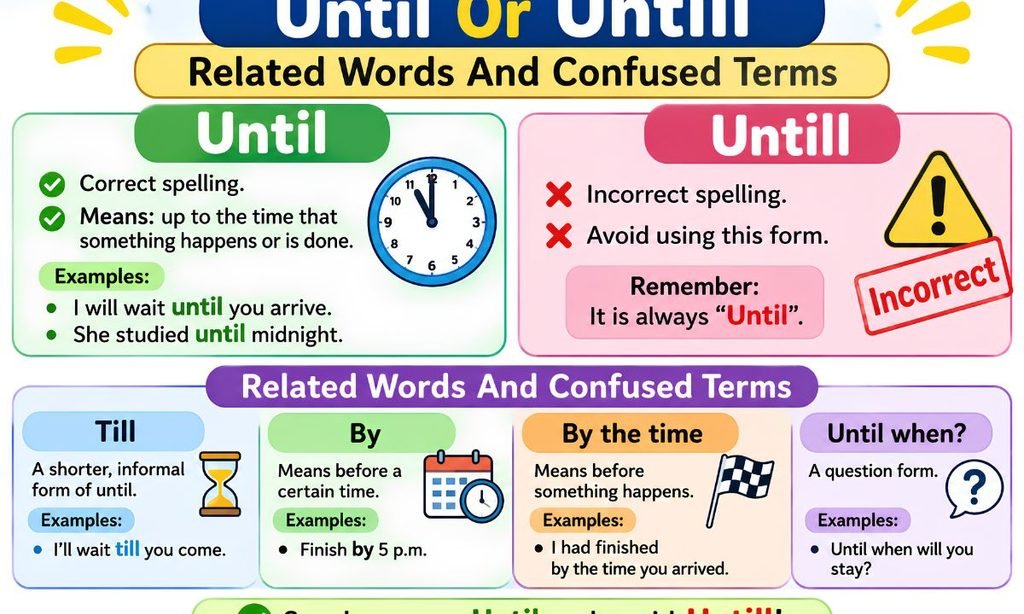
Until has several neighbors that look or sound similar. Here is how to tell them apart.
Till
Till means the same thing as until in most sentences. It is more casual and is sometimes written with an apostrophe as ’til.
- Wait till I get back. (Casual)
- Wait until I get back. (Standard)
By
By shows a deadline. It means “no later than.” Until shows how long something continues.
- Submit the form by Friday. (Do it any time before or on Friday.)
- Keep the form open until Friday. (It stays open through Friday.)
This is one of the most common mix-ups in English, so it is worth remembering.
Before
Before means earlier than a certain time. It does not always point to a boundary in the same way as until.
- Finish this before dinner.
- Keep working until dinner.
The first one places the action earlier than dinner. The second one says the action continues up to dinner.
Unless
Unless sets a condition. It means “if not.” It has nothing to do with time.
- I will not go unless you come too.
- I will not go until you come too.
The first means “only if you come.” The second means “I will wait for you to come.” The two look close, but the meaning changes.
As Long As
As long as means “for the whole time that” or “provided that.” It can show duration or condition.
- You can stay as long as you like.
- You can stay until midnight.
As long as is open-ended. Until sets a clear stopping point.
Expert Language Insight
Language experts often point out that until is one of the few English words that points to both a time and an event at once. It can mean “up to 5 p.m.” and “up to the moment the bell rings.” That double role makes it very useful.
Editors also note that the until vs. untill error is a good example of a visual mistake, not a sound mistake. Because the word is spoken the same way either way, the error only shows up in writing.
This is why proofreading by eye, or by software, is so valuable. Your ears will not catch it.
Another expert note: until is considered a “closed class” word, which means English rarely changes it. Spelling shifts of this kind are very unlikely to happen in the near future.
Advanced Usage Tips
Once you master the spelling, you can sharpen how you use until. These tips help your writing sound polished.
Use Until To Show An Ending Point
Until works best when something continues and then stops. If there is no clear continuation, another word may fit better.
- Correct: We worked until the sun set.
- Weaker: We finished until the sun set.
The first sentence shows an ongoing action. The second does not make sense.
Choose Until In Formal Writing
For reports, cover letters, academic papers, and business emails, choose until over till. It sounds more professional.
Tip: Save till and ’til for relaxed conversation. Use until when you are not sure about the tone.
Avoid Repeating Until Unnecessarily
If a paragraph has three until clauses in a row, it can feel heavy. Try mixing in other phrases, such as “up to,” “through,” or “before.”
- Heavy: Wait until noon, then wait until the bell, then wait until I call.
- Better: Wait until noon. After the bell, I will call you.
Your reader will thank you.
Match The Time Reference
Make sure the tense matches the time you describe. For future plans, use the present tense after until.
- Correct: I will wait until you arrive.
- Incorrect: I will wait until you will arrive.
This tense rule is very common in English and is worth memorizing.
Easy Memory Tricks
Here are four quick tricks to lock in the right spelling in the until or untill debate.
1. Remember That Dictionaries Use One
Every trusted dictionary lists until with one L. If you ever feel unsure, look it up once. After that, the picture usually stays in your mind.
2. Think Of The Ending
The word ends with -til, like the start of “tiling.” Picture one L standing tall at the end, like a single flag on a pole.
You can also use this mini rhyme: “One L is enough, until is not tough.”
3. Let Spell Check Confirm It
Turn on spell check in your email, phone, and document apps. It will underline untill in red. Treat that red line as a friendly reminder.
Do not rely on it blindly, but use it as a safety net.
4. Read Quality English
Books, respected newspapers, and academic sites show the right spelling over and over. The more you read well-edited writing, the more natural until will feel.
Why Do People Write Untill
The until vs. untill mix-up is not about being careless. It has understandable causes. Here are the main reasons.
Double Letter Patterns
English has hundreds of words that end in double L. Your brain loves patterns, and it may apply the double L rule to until without asking you.
Words like “until” break that pattern, and that is exactly why they trip people.
Fast Typing
When you type quickly, your fingers may repeat the last letter. Texting, chatting, and typing on small phone keyboards make this more likely.
The error is a motor slip more than a knowledge gap.
Visual Familiarity
If you have seen untill in posts, captions, or comments, it can start to look right. This is called visual familiarity bias. The more you see an error, the less strange it looks.
The cure is simple. Check the spelling once, then replace the wrong image in your memory with the right one.
Editing Tips For Better Writing
Good editing catches the until or untill slip before anyone else sees it. Try these habits.
- Read it aloud. This slows you down and helps you notice odd spots.
- Search your document. Use Find and look for “untill.” Replace every match.
- Change the font size. A different view can make errors pop out.
- Read from the bottom up. This breaks your normal flow and exposes typos.
- Take a break. Fresh eyes spot more mistakes than tired ones.
- Use a grammar tool. Software can catch common errors fast.
Tip: Keep a small personal list of words you often misspell. Add untill if it is on your list. Review it before you hit send.
Until In Everyday Situations
Until shows up in almost every part of daily life. Here are some situations where you might use it.
Family Conversations
- “No dessert until you finish your dinner.”
- “We will stay at Grandma’s house until Sunday.”
- “Wait until Dad gets home.”
Family talk is full of short, simple until phrases.
School
- “You may not leave until the bell rings.”
- “Keep reading until page 50.”
- “The project is due, and we will work on it until the last day.”
Teachers circle untill in red ink, so students benefit from knowing the single-L rule early.
Workplace
- “The invoice stays open until payment arrives.”
- “Please wait until the manager approves.”
- “The office will be closed until further notice.”
Clear, correct spelling supports a clear, trustworthy image.
Travel
- “The museum is open until 5 p.m.”
- “Your ticket is valid until the end of the month.”
- “Stay in your seat until the plane stops.”
Signs, tickets, and booking pages use until constantly. You will almost never see untill on a professional sign.
Until Or Untill Final Comparison
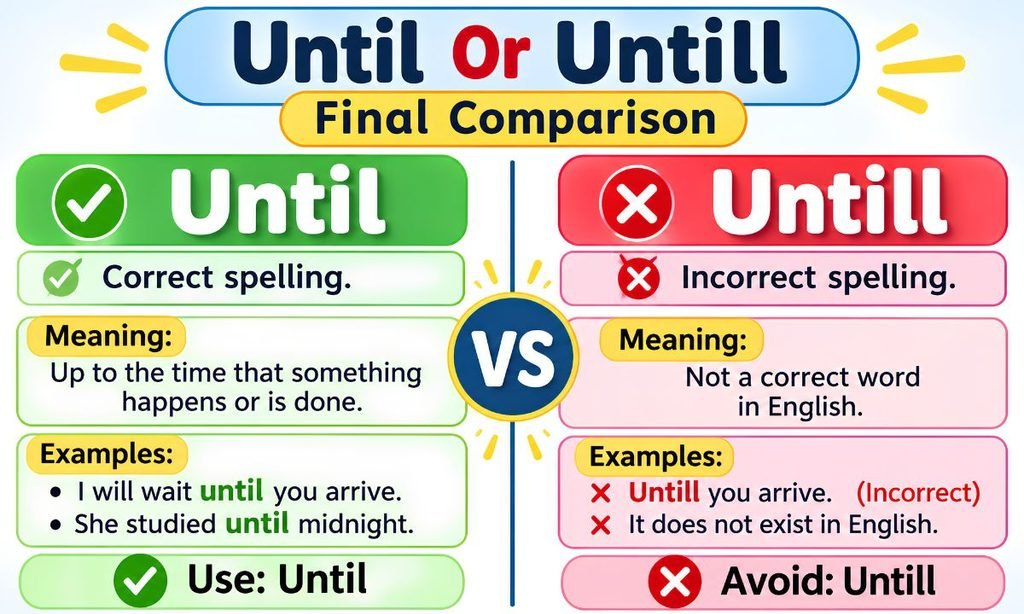
Here is the final side-by-side look at until vs. untill, so you can lock in the answer.
| Question | Until | Untill |
|---|---|---|
| Is it a real word? | Yes | No |
| Do dictionaries list it? | Yes | No |
| Is it accepted in exams and professional work? | Yes | No |
| Does spell check pass it? | Yes | No |
| Should you use it? | Always | Never |
The until or untill matter is settled. One spelling is right, and one is a common slip.
Frequently Asked Questions
Which is correct, untill or until?
Until is correct. It has one L and is listed in every major dictionary. In the until vs. untill comparison, untill is only a misspelling.
When to use until and untill?
Use until every time. There is no situation where untill is the right choice. If you mean “up to the time that,” write until. The until or untill rule never changes by context, region, or tone.
How to use until correctly?
Place until before a time, a date, an event, or a clause to show where something stops. For example: “We will wait until noon” or “Keep walking until you see the sign.” Remember to use the present tense after until when talking about the future, as in “until you arrive.”
Which is correct: “until 7” or “till 7”?
Both are correct. “Until 7” is slightly more formal, and “till 7” is more casual. For emails, reports, and school work, choose until. For friendly chats, till is fine.
Is it correct to say “till date” or “till now”?
“Till now” is correct and common in speech. “Until now” is the more standard and formal version. “Till date” is widely used in some regions, especially in business and official writing in South Asia, but many style guides prefer “to date” or “until now” in international English.
What does “untill” mean?
Untill has no meaning of its own. It is a misspelling of until. When people write it, they almost always mean “up to the time that.” To fix it, remove one L and write until.
Conclusion
The until vs. untill debate has a short and friendly answer. Until is correct, and untill is a mistake. This is true in American, British, Australian, and Canadian English, in formal and casual writing alike.
The extra L usually comes from double letter patterns, fast typing, and visual familiarity. Check a dictionary, read aloud, and let spell check help. Remember the finish line idea, and mastering until vs. untill will make your writing look sharper.
